Lazo negro
In memoriam víctimas de Urda (Toledo)

lunes, 13 de agosto de 2012

Documentos que acreditan la legitimación del actor: el art. 45.2.b) LJCA

Sucesos contemporáneos · Serie microensayos

Documentos que acreditan la legitimación del actor: el art. 45.2.b) LJCA

¿Puede el tribunal exigir, ya en el escrito de interposición, la prueba documental de la legitimación? Entre la tesis de la cuestión de fondo y la del presupuesto procesal, la jurisprudencia ha abierto una vía intermedia: control temprano, sí, pero siempre con oportunidad de subsanar.

Por Juan B. Lorenzo de Membiela
⏱ 10 min de lectura

Las Salesas Reales o Palacio de Justicia, Madrid, hacia 1880-1890.
Las Salesas Reales ó Palacio de Justicia, Madrid (h. 1880-1890). Impresión fotomecánica, Rijksmuseum, Ámsterdam. Convertido en Palacio de Justicia en el último tercio del siglo XIX, el antiguo convento es hoy la sede del Tribunal Supremo. Fuente.

Sinopsis

Idea principalConclusión
Naturaleza de la legitimaciónPara parte de la doctrina es cuestión de fondo; para Montero Aroca, presupuesto procesal.
Control in limine litisEl tribunal puede verificar la legitimación desde el escrito de interposición.
Principio pro actioneTodo defecto documental subsanable debe advertirse antes de inadmitir (arts. 45.3 y 138 LJCA).
Expediente administrativoSi la legitimación ya consta en él, la exigencia documental se pondera y la inadmisión resulta desproporcionada.
Legitimación derivativaCuando se adquiere por herencia u otro título, la sucesión ha de probarse documentalmente.
Texto vigenteEl art. 45.2.b) LJCA ciñe la carga documental a la legitimación transmitida.

Cronología normativa, 1978-2015

1978Constitución Española
Art. 24.1: tutela judicial efectiva
1998Ley 29/1998
Legitimación (art. 19) y documentos del escrito de interposición (art. 45.2)
2000Ley de Enjuiciamiento Civil
Supletoria en materia de legitimación
2015Ley 39/2015
Interesados en el procedimiento (art. 4)

I. ¿Cuestión de fondo o presupuesto procesal?

Se esgrime por algún autor, sobre la base de la jurisprudencia del Tribunal Supremo1, la imposibilidad de que el órgano jurisdiccional fiscalice la concurrencia de los documentos acreditativos de la legitimación —y, por ende, la legitimación misma— en la fase inicial del recurso2.

La razón de esta afirmación radica en su consideración como cuestión de fondo y no como presupuesto procesal cuya falta determina la absolución en la instancia; es decir, como presupuesto de la fundamentación de la demanda3. Esta postura se aparta de la acogida por el legislador, que examina la legitimación como requisito previo al examen de la litis.

Sin embargo, aunque la consideración de la legitimación como cuestión de fondo es admitida por la generalidad de la doctrina, Montero Aroca discrepa de esta tesis por las razones siguientes:

Las tres razones de Montero Aroca

1. Las normas que regulan la legitimación son siempre procesales.

2. La falta de legitimación del actor o del demandado aboca a una sentencia meramente procesal, que no entra en el fondo del asunto.

3. En ocasiones será posible debatir y resolver sobre la legitimación in limine litis, sin esperar a que el proceso concluya por sentencia4.

II. Control temprano y deber de advertir el defecto

Sobre estas consideraciones, el órgano jurisdiccional podrá, aun en la fase del escrito de interposición, verificar la legitimación del recurrente exigiendo la aportación de los documentos que la justifiquen. Y, sobre esa naturaleza procesal, cabe aplicar la doctrina constitucional que defiende una interpretación pro actione de aquellas cuestiones procesales que impiden el acceso a la jurisdicción, entre ellas, la legitimación5.

En el proceso contencioso-administrativo, es necesario aclarar que la condición de legitimado vendrá determinada por la concurrencia en el recurrente de la titularidad de un derecho o interés legítimo6.

La facultad del tribunal de examinar los documentos justificativos de la legitimación le impone la obligación de advertir al recurrente de cualquier defecto para su posterior subsanación7. Así lo declara la STSJ de Aragón de 13 de febrero de 19978, FD quinto:

«Por último, en el fundamento II de la demanda, solicita, que no en el suplico, la declaración de inadmisibilidad del procedimiento por concurrir la excepción regulada en la letra b) del art. 82 de la Ley Jurisdiccional (RCL 1956\1890 y NDL 18435), y dado que ambas han interesado un pronunciamiento de fondo, recordar con la desestimación de la petición la doctrina del Tribunal Supremo, según la cual la necesidad impuesta por el art. 82, b) de la Ley Jurisdiccional, de acompañar con el escrito de demanda el documento o documentos, que acrediten la legitimación con que el actor se presenta en juicio, no tiene otro alcance que el de evitar que se inicie un proceso por quien no esté legitimado para ello, con la subsiguiente consecuencia de ineficacia del mismo, al no poder afectar la decisión de fondo que recaiga a los legítimos titulares del derecho objeto del juicio. La «ratio legis» de tal norma procesal debe relacionarse, a fin de interpretarla correctamente, con los derechos fundamentales al proceso y a la tutela judicial efectiva en el ejercicio de derechos e intereses legítimos, reconocidos por el artículo 24 de la vigente Constitución (RCL 1978\2836 y ApNDL 2875), de cuya interrelación se deriva la conclusión de resultar indebida la declaración de inadmisión de la acción si los defectos formales que pudiera tener fueran subsanables […]».

STSJ de Aragón de 13 de febrero de 1997, FD quinto (RJCA 1997\2577).

III. Cuando la legitimación consta en el expediente

Ahora bien, si la legitimación del recurrente consta en el expediente administrativo —actuación anterior al proceso—, cabe ponderar la exigencia establecida en el art. 45.2.b) de la LJCA de 1998. Véase la STS de 20 de junio de 19969, FD tercero:

«Como esta misma Sala y Sección del Tribunal Supremo ha declarado, entre otras, en sus Sentencias de 5 junio 1993 (RJ 1993\4363) (recurso de apelación 11352/1990) y 26 marzo 1994 (RJ 1994\1892) (recurso de apelación 2284/1991, fundamento jurídico primero), la necesidad, impuesta por el artículo 57.2, b) de la Ley de la Jurisdicción Contencioso-Administrativa, de acompañar con el escrito de demanda el documento o documentos, que acrediten la legitimación con que el actor se presenta en juicio, no tiene otro alcance que el de evitar que se inicie un proceso por quien no esté legitimado para ello, con la subsiguiente consecuencia de ineficacia del mismo, al no poder afectar la decisión de fondo que recaiga a los legítimos titulares del derecho objeto del juicio. […]

En conclusión, la decisión de la Sala de primera instancia, al inadmitir el recurso contencioso-administrativo por no haberse interpuesto previamente recurso de reposición y por defecto de legitimación activa de la demandante, ahora apelante, no sólo fue innecesaria porque el defecto hubiera sido subsanado de haber la propia Sala cumplido con lo dispuesto en los artículos 57.3 y 129.2 y 3 de la Ley de la Jurisdicción Contencioso-Administrativa, 11.3 y 243 de la Ley Orgánica del Poder Judicial, sino que es inidónea y desproporcionada, porque de los documentos que aparecen en el expediente administrativo y de las actuaciones practicadas en dicha vía, a las que antes hemos aludido, se deduce que la demandante y ahora apelante actuó tanto en vía administrativa como en sede jurisdiccional en interés y beneficio de la Junta de Compensación del Polígono de La Fresneda […]».

STS (Sala 3.ª) de 20 de junio de 1996, FD tercero (RJ 1996\4891).

Idéntica doctrina sostiene la STS de 26 de marzo de 199410, FD primero:

«En conclusión, la decisión de la Sala de primera instancia, al inadmitir el recurso contencioso-administrativo por no haberse presentado con el escrito de interposición el documento que acredite la representación con la que compareció en juicio el demandante, ahora apelante, no sólo fue innecesaria porque el defecto hubiera sido subsanado de haber la propia Sala cumplido con lo dispuesto en los artículos 57.3 y 129.2 de la Ley de la Jurisdicción Contencioso-Administrativa y 11.3 y 243 de la Ley Orgánica del Poder Judicial, sino que es inidónea y desproporcionada, porque de los documentos que aparecen en el expediente administrativo y de las actuaciones practicadas en dicha vía […] se deduce […] que el demandante y ahora apelante actuó tanto en vía administrativa como en sede jurisdiccional en beneficio y como Presidente de la Comunidad de Vecinos […]».

STS (Sala 3.ª) de 26 de marzo de 1994, FD primero (RJ 1994\1892).

IV. La legitimación derivativa

Cuestión diferente es la sucesión en la legitimación, cuando el recurrente la haya recibido de otra persona por herencia o por otro título. En tal caso, deberá justificarse mediante la aportación de los documentos que acrediten la sucesión11. En esta línea se pronuncia la STS de 2 de abril de 198012, considerando tercero:

«Que tampoco resulta acreditada la legitimación de la actora, H.-F. E., S. A., pues dimanando, según sostiene dicha parte, de habérsele transmitido durante la tramitación del expediente los derechos derivados de la solicitud de inscripción de la marca núm. 693.390, por exigencia impuesta en el art. 57.2.b) de la Ley Jurisdiccional tendría que haber acompañado al escrito de interposición del recurso la prueba documental acreditativa de tal extremo o, al menos, haber subsanado su falta, una vez denunciada por el Sr. Abogado del Estado la ausencia de prueba de este requisito procesal, por el cauce que le brindaba el art. 129 de la expresada Ley, pero es lo cierto que lejos de adoptar una postura diligente ha adoptado una actitud pasiva, incluso cuando la propia Sala, en diligencia para mejor proveer, acordó que fuese requerida para que tuviese una nueva ocasión de aporta[r] la justificación documental de la transmisión de derechos invocada, por lo que ante tal tesitura no puede caber otra solución que la de acoger el motivo de inadmisibilidad aducido por la Administración demandada al amparo del art. 82.b), en relación con el 28.1.a), de la repetida Ley […]».

STS de 2 de abril de 1980, considerando tercero (RJ 1980\3087).

Pese a la distinción expuesta en este estudio, algún autor estima que la facultad que el art. 45.2.b) de la LJCA de 1998 concede al órgano jurisdiccional para fiscalizar la documentación de la legitimación no se refiere a la originaria, sino a la derivativa; es decir, cuando el recurrente no es el directamente afectado, sino la persona que lo sustituye por transmisión inter vivos o mortis causa13.

Nota de actualización (2026)

El texto vigente del art. 45.2.b) LJCA, inalterado desde 1998, avala esta última lectura: exige acompañar al escrito de interposición «el documento o documentos que acrediten la legitimación del actor cuando la ostente por habérsela transmitido otro por herencia o por cualquier otro título»14. La legitimación originaria no se documenta en ese momento; su falta se ventila por la vía de los arts. 51.1.b) —inadmisión cuando conste «de modo inequívoco y manifiesto»— y 69.b) LJCA.

El deber de advertir el defecto, que la jurisprudencia citada construyó sobre los arts. 57.3 y 129 de la ley de 1956, figura hoy en los arts. 45.3 y 138 LJCA: requerimiento de subsanación en el plazo de diez días, que corresponde ahora al letrado de la Administración de Justicia15. Solo el defecto insubsanable, o no subsanado en plazo, permite decidir el recurso con fundamento en él (art. 138.3).

La tesis procesal de Montero Aroca encuentra eco en la jurisprudencia reciente: la inadmisión por un defecto documental de la comparecencia es un pronunciamiento meramente formal, sin efecto de cosa juzgada material, que no impide reproducir la impugnación16.

Notas

  1. Por todas, SSTS de 19 de enero de 1963 y de 11 de abril de 1973. ↩
  2. Fernández Daza: comentario al art. 51, en Comentarios a la Ley de la Jurisdicción Contencioso-Administrativa de 1998, Revista Española de Derecho Administrativo, n.º 100 (número monográfico), Madrid: Civitas, 1999, p. 427. ↩
  3. Cordón Moreno, F. (1979): La legitimación en el proceso contencioso-administrativo, Pamplona: Eunsa, p. 102. ↩
  4. Montero Aroca, J. (1995): La legitimación en el proceso civil, 1.ª ed., Madrid: Civitas, p. 35. ↩
  5. Vid. STC 93/1990, de 23 de mayo (RTC 1990\93), FJ 2. ↩
  6. García-Trevijano Garnica, E.: comentario al art. 45, en Comentarios a la Ley de la Jurisdicción Contencioso-Administrativa de 1998, cit., p. 400. ↩
  7. Cfr. Lafuente Benaches, M. (1984): «La legitimación para impugnar actos y disposiciones administrativos después de la Constitución», Revista Española de Derecho Administrativo, n.º 42. ↩
  8. RJCA 1997\2577. ↩
  9. RJ 1996\4891. ↩
  10. RJ 1994\1892 (rec. de apelación 2284/1991). ↩
  11. Cuestión tradicional en nuestro Derecho, como puede verificarse en los AATS de 30 de junio de 1891, 24 de abril de 1893, 16 de marzo de 1894 y 6 de junio de 1895, y en las SSTS de 31 de marzo de 1892 y 18 de febrero de 1897 (González Pérez, J.: Derecho procesal administrativo, t. II, p. 677, nota 32). Cfr. Fernández Daza: comentario al art. 51, cit., p. 427. ↩
  12. RJ 1980\3087. ↩
  13. García-Trevijano Garnica, E.: comentario al art. 45, cit., p. 400. ↩
  14. Ley 29/1998, de 13 de julio, reguladora de la Jurisdicción Contencioso-administrativa, art. 45.2.b), texto consolidado: BOE-A-1998-16718. ↩
  15. Arts. 45.3 y 138.2 LJCA, en la redacción de la Ley 13/2009, de 3 de noviembre. La Ley Orgánica 7/2015, de 21 de julio, dispuso (disp. adic. 1.ª) que las referencias a los secretarios judiciales se entiendan hechas a los letrados de la Administración de Justicia. ↩
  16. STS (Sala 3.ª, Secc. 4.ª) 1126/2020, de 27 de julio, rec. de casación 899/2019, ponente: Inés Huerta Garicano, referida a la falta del documento del art. 45.2.d) LJCA. ↩

Para seguir leyendo

Publicado originalmente en 2012; revisado y actualizado en octubre de 2026. Imagen: Rijksmuseum, vía Wikimedia Commons (CC0).

viernes, 10 de agosto de 2012

The lie and his deception (8 min.)


The lie and his deception (8 min.)

The lie and his deception
Juan B. Lorenzo Membiela

There are those who are in the lie a way of life and an experience mystical, delirious, seem to be what they want to be, not so. The comic it is deceit destroys coexistence and degrades society or a hell or a grotesque comedy.

Interpersonal relationships exist because we are confident in the honesty and good faith of others. If people who surround us us lie, life becomes unbearable. We do not repair it and however is of crucial importance.

Phylogenetically conditioned to live in community, the frustration of deception leads us towards a social and emotional self-sufficiency. To asocial wagers. This idea is not extravagant. The reintegration into society may not produce anything other than a single amputation. The axiom of Ovid is revealing: 'Division, qui bene vene latuit' (well live who is well hidden).

The romanticism of century XIX, born on turbulent scenarios, reverenced the individual before the vacuity of the national. Perhaps today will see a romantic lyricism because social has been adulterated so that can only be found epic on those who defy the hypocrisy. To the folly of the times. Without major concessions.

But this is difficult. Today the deception is utilitarian. As long as me to be profitable, the falsehood is something without relevance. It was not always like this and even today there are a few exceptions.

Communities are built on good faith.

Social status is built on the solvency and honesty of others, develop scientific research, are granted credits and agree investments. This more or less convincing representations framework is maintained only by the morality and its effects.

Man is the only animal that can control the mode and way to represent to others. The relevance of that truth or lie is measured by the degree of commitment with their peers.

Indifference towards others, denial of assistance and relief, inhumanity, civic selfishness in short, could be explained by a sceptical on alien honesty. From here everything is brutality. «Human barbarism engenders cruel gods which, in turn, encourage humans to barbarism» (Morin, 2009). It is the same as saying that the lie engenders lie that in turn encourages people to surrender to stormy of deception. And this elusive man the most basic thing that has and that is its ability to relate to others sincerely.

Someone said that the reason is tame instincts but does not indicate the lie a perversion of reason to return to the instinct but always in selfish advantage?

Deception reaches an intellectual superiority that allows a domain of few over many. It is an absolute that is born of the spirit, so brutal and effective as physical force (Simmel, 2010: 37). Who not has seen succumb to brave by deception of others? Who has not contributed, with the involuntarity of ignorance, to all this?

Totalitarianism in the lie does not constitute any problem because there is no freedom. Hence the geometry deception/totalitarismo-verdad/freedom reaches a decisive relevance. But the man «things» do not have this Apollonian structure showing unwarranted amorfismos. Deception/truth and totalitarianism/freedom usually appear in the same oil.

The credulity of the people is so deep that he assumes the last only being it. When injustices supports a people but when it is unable to take account of them? (Friedrich Richter, 2012: 89).

It is terrible because the credulity of citizens and voters is a failure that makes it easy to govern comfortably without greater commitments, without greater excellence. But who cares about these things?

Lies should not coexist in a democracy because nothing can escape the application of the law (De Lucas, 1990). Not always is the effectiveness of the law. It is not uncommon that justice who seek to find earlier in the benevolence and compasividad of their enemies. Noble gesture on the edge of the sublime. Why open that marble closes...

Our Constitution protects the veracity of the information, but I am afraid that the deception always exists for the benefit of the elites and always to the detriment of the mass. It is somewhat apodictic, without nuances, orphan of ideologies and profoundly human.

The truth makes all while deception benefits a few. Demands today transparency in any activity, public and private, are trying to, at least, compensate that soon there. Not to mention that by 2007 the ethical demands of absolute nature did not serve but to waste editorial artifice without greater impact.

Forecast in crisis (7 min.) (more than wait events)

Forecast in crisis (7 min.) (more than wait events)

Forecast in crisis (7 min.)
(more than wait events)

Juan B. Lorenzo Membiela

Unemployment affects not only the person, but the environment in which it operates. Giddens, on studies conducted by Jahoda noted the weakening of social ties and communities: the unemployed were less involved in public affairs, relate to least and least visit your city library... (Jahoda, 1982).

These facts, referential, are indicative of consequences for the man in your life and political dimension. It auto-excluye any citizen role. It alienates its public sphere that by natural law and of private or family, which belongs to you by affection.

Jouvenel, the Centre of political life is family.

After being eroded by postmodernism, creating the so-called "mass man," person without spiritual and only public links, sunk in the exclusive hedonism of complacency. But this happened. Only the family has served and serves as unacceptable challenges to the unemployed and also for a State that supports previous and future mortgages.

Under the conflict or crisis attended so-called "resilience", etiological concept applied to social processes and it is defined as a dynamic process that has the adaptation as a result positive in contexts of great adversity (Luthar, Cicchetti and Becker, 2000).

Develop behavioral strategies to promote "resilience" must become objective of a proactive health policy towards the phenomenon of unemployment, and more when it is systemic.
Also implemented in programmes of education at all levels to complete the training for a future where the roads fade away.

Forecasting not only prevention.

Unemployment, to be serious, does not justify a committal to an alienating neo-capitalism demands. Litim, of the University of Paris, lists the consequences of a requirement of efficiency and extreme productivity: occupational cancers, reactive somatizations to a hostile environment and suicides.

In France claims numerous autoliticos in the «France Télécom» company was striking. During the years 2008 to 2009 the figure reached 35, something unusual. The events that followed during 2010 and 2011.

The Paris Prosecutor's Office opened an investigation for harassment in April 2012. French labour inspection analyzed in his report cases of suicide, but also attempts suicide and depression that was caused by the personnel of the former State-owned monopoly French policy. Excessive pressure, exacerbation of productivity without defined objectives, taxes and induced fears, uncertainty, confusion.

This was caused by the need to restructure the template. He spoke of lay off 22,000 employees. Strategies consisting of the increase of work, assuming management primitive designs, typically Asian, are difficult implementation to those who have taken labor principles by an evolution in the way of delivering the work.

Without a strategy change management, proper, and the use of severe management measures the psychological collapse is a likely option.

Human resources policies have resulted in a resounding failure. Very few leaders are sensitive to this situation, or because they do not know or can not, indication of the crisis of humanism.

Planning which alleviate adverse effects "of the crisis" and "in crisis" is Miss. Corporate Social responsibility has been inoperative. The ecological component has disappeared and sustainability is no longer regarding any. But the man is unavailable.

United Kingdom adopted in 2009 through its Ministry of health, a plan of colliding with the effects of the crisis through psychological and medical assistance to alleviate lower levels of mental well-being. The measures proposed were:

1. Training of therapists and nurses to create a network of units of psychological distress in employment offices and outpatient primary care physicians at the end of 2010.
2. Creation of a helpline to assist those who have been plunged into depression due to economic problems.

Do the proper things does not make things right. Make them with the integrity of passes excellence by the obligation to empathize with all the human element and provide assistance to the most needy.

I speak from honesty to those who sincerely are at critical crossroads.

FINANCIAL SERIOUSNESS AND SINCERITY OF THE MAN (9 MIN.)


FINANCIAL SERIOUSNESS AND SINCERITY OF THE MAN (9 MIN.)

By

Juan B. Lorenzo Membiela (c)

After the «historical» European Summit ended on 29 June, the German newspaper "Die Welt" published on its front page: "Europe arrives for our money". It is a terse summary of a reality that is not entirely correct. It is true that Germany is compromised by what was agreed at the Summit even her German Federation of savings, but not yet.

German Parliament, then to the Summit, agreed by two-thirds accessions to the Fiscal Pact and the European Fund for stability and sustainability (improperly called bailout Fund). From July 1, 2012 is replaced by the European stability mechanism (MEDE), known by the acronym English ESM (European Stability Mechanism).

It is a temporary relief for countries in crisis, since then it is hoped that the risk premium will not rise to such high dimensions. Extreme premium that is due to the inadequacy of structural measures stimulating competitiveness. I.e., that the risk premium indicates the need for further reforms.

However, the Chairman of Germany, Mr. Joachim Gauck, not sign these laws passed by the German Parliament until the German Federal Constitutional Court (Bundesverfassungsgericht) to decide on the appeals lodged by the regional leaders even of the same political party that Chancellor Merkel, the Christian Democratic Union (CDU).

Deserves attention this circumstance because the German tribunal's jurisprudence is not prone to transfers of sovereignty to Brussels. Some adverse judgments contributed to the holding of regional or national plebiscites and commit the viability of the European stability and sustainability fund, at least temporarily.

The MEDE can be injected directly into the banks of the countries which so request an immediate liquidity to avoid insolvency. Its funds are guaranteed by all States members of the EU and have a capacity of 440 billion loan €.

The lender is rated by Moody's as "Aaa" by Fitch Ratings and "AAA" by Standard & Poor's as "AA +".

The struggle of Chancellor Merkel, in defense of strict policies of austerity against Spain, Italy and France has noticiado in excess. That these nations blocked any other option that wasn't an endorsement for the euro and the so-called «policies of growth».

I don't think that win or lose in this lance has relevance. Yes there was and there is distrust of the adoption and operation of structural measures "in depth" in the affected countries. And a price that will be added to the types that shall be imposed on the loan that you grant the MEDE. Measures stimulating for competitiveness extensible to a greater or lesser extent throughout the European Union. Spain and Italy are not the only problem but cement the problem.

The prevailing mistrust - cause of the high risk premium - is that will motivate that along with banking and tax measures be accompanied different ones that streamlined the State of welfare, labour, public relations and private, and in general, a transfer of sovereignty in favour of the European Commission which will be more sparing in the maintenance and Latin cutting subsidies.

The Greek example, not long ago, evidence of how after winning an election parties Europhiles, radically changed program avoiding any compromised structural decision. Intra-Community insincerity has unpleasant consequences especially for countries whose liquidity will be committed even to pay for essential services.

No doubt the European control over the money that is paid will be scrupulous (Gertrud r. Traud, 2012). Well is not an investigation into the causes of this situation. But one of them, is certainly an institutional wear that began decades ago and that has stunning to who for its mission should have acted with forecasting and prevention. Without a doubt what is and what ought to be a managerial position in the Administration has been forgotten in its very essence, that is, without more, a public and institutional Sector for a good general and common.

This fact confirms called «determinism institutional» 2011 (Inglehart), by which a society institutions integrate culture formed in that society. I.e. worn institutions encourage worn societies, as integrity institutions encourage societies intact.

Financial inconsistencies flagged mistrust that prevent the crisis leave. Questionable is not so restrictive measures but positive, creative. For example, the design of efficient processes in industry or services to increase productivity, flexible management looking for greater commitment to the operator, freedom of trade to tackle the crisis with autonomy without being bound by regulations which hinder competitiveness, the creation of international networks that facilitate the installation of factories or companies outside of the European Union, the empowerment of the electronic market, limited deregulation to the free market ultimately.

These are times of epic not opportunists. It is time for the poetic deception that says ailing truth. The political demagoguery nothing solved already. The designed stagings have been left without applause by an empty Auditorium.

The deconstruction of what Europe has meant as a civilization or image advanced from what should be a modern world is in decline. Neither India, nor China, nor Brazil, nor other powerful and emerging economies have invested in social protection that this old continent has spent. Neither adopts nor programs that encourage initiative and creativity in its citizens.

It is the time in which everything must be streamlined in proportion to the economic viability of each State and insecurities that must be controlled by the knowledge that entails. Modernity has another very different way whose epicenter is not exactly the man but financial. Some say that it is the same, because both the one and the other thrive in chaotic in self-dealing and it is possible that he is right. With humility, let us recognize that the problem is in each of us, not in others.

Come on purpose the words from  William e. Henley:

« […] In the fierce grip of circumstances
I have regretted nor I gave shouts.
Under the blows of the random
My head bleeds, but will not tilt [...] » .

martes, 7 de agosto de 2012

Parallels between the crisis of 1929 and 2007 (9 min.)


Parallels between the crisis of 1929 and 2007 (9 min.)

by

John B Lorenzo d Membiela
PhD from the University of Valencia


"The decline of the West", Spengler explains the cyclical character of civilizations and their destruction as the last phase. This inevitable end generates in the tragedy of circumstances, an unconditional resignation. Resignation, which often served to soportad fatalities. Today also to uncertain of day to day and afraid to lift the gaze to scrutinize to the more immediate future? Nothing can object to the rulers of today because nothing objected to the rulers of yesterday. Only that the yesterday and today have been blurred tomorrow.

The crisis of 1929 has been studied as a manifestation of a cyclic economy in both the concurrence of similar financial and economic behaviors. Especially the exhaustion of opportunities due to an overexpansion of consumer demand and investment, the so-called localiser (2009: 308 Kindleberguer).

Their effects during subsequent years show us aspects currently contributing but not all. In essence, remain emotions that are unalterable, whatever of the historical moment, because they belong to the nature of the man who has remained unchanged. And to them it must seek to explain behaviors that may appear to be erratic.

The cycle that repeats itself is composed of the liquidity crisis, by extravagant public budgets by decreases in prices that break the monetary system, by a gross investment of close to zero and, finally, by a banking Apocalypse (Rostow, 1971: 84).

Get to know circumstances of 1929 and subsequent years can help us avoid falling more deeply because knowing how to swim in the "forms" of communication prevents that "funds" is more immerse into the abyss. The emotional economic has operated in positive and negative. Notable examples:


(a) the fear of investors perceptions or negative news about the financial solvency of a country. It is not its authenticity, only proof of a rumor wrong, futile. Generated panic and anxiety of liquidity which led to the sale of securities and currencies.

This occurred after a statement from Hoover in Des Moines (Iowa, USA) on October 4, 1932, when he mentioned "how close to us had been leaving the pattern gold (...)". This comment sparked a global wave of financial speculation against the dollar.

Another example, the cancellation of deposits in New York in 1929 by foreign investors, banks and corporate America foreign without any reason. It generated losses to individual investors. These, in turn, to compensate their losses, made their mortgages, resulting in the majority of cases, mass evictions.

The housing prices quickly fell along with raw materials and automobiles. In August 1929 contracted sales of vehicles, from 440,000 to 319.000 in October; to 169.500 in November and December 92.500 (Butler, 1969).

(b) recovery of confidence. Britain regained the confidence of international markets in the pound in January 1932.

The British Government announced that the Bank of England would meet the payments of credits in the summer of 1931 without affecting their stock of gold. Also reported the advance and voluntary payment of the income tax in January when it should be in March (see the study of Einzing, p., "The Comedy of the Pound", 1933, p. 56).

The purpose to be achieved was to stabilize the pound to the gold value but also restore to London as a global financial centre (Einzing, 1935), which today, in the 21st century aims to the detriment of Germany.

Financial subtlety not married the abrupt reality of facts. And this it can be concluded that the financial market is sensitive to the suspicion, without more. Marketing on financial corrections "policies" made by leaders have been able to provide a picture of economic strength that the dessert has yielded positive results, at least in the short term. We live in lies, in the virtual, but in the end and after even dying.

Claim attention to unnoticed fact, that it has not deserved any comment. An organic law of budgetary stability for all administrations was published in 2001. This rule allowed the autonomous communities to take the necessary measures to achieve the zero deficit with an increase in public revenue policy, either through reduction of costs, and without that can resort to a higher debt as a way of financing production.

The purpose of it was truncated in 2006 to amend substantially the 2001 Act and participate all of a new regulatory framework which invited walk in any way in full bubble that enriched via tax administrations.

Today the architecture of the time invites reflection on the decadence embodied by Gongora in their "solitudes". Relentless suffocation of an economy whose internal structure is misunderstood. Denaturation of the human context. The ethics of diffuse towards an evocative narcissism of the bucolic lived traffic. From national to the Empire and the Empire to the village as a catalyst for the vileness of men and the decline of abandonment and loneliness. His verses are:

Those little trees
Cease to be towers today (...)
The stars night lights
They were of their battlements (...).
They lie now, and its bare stones
They dress pious Ivy:
That havoc and ruins
Know the time making green praise (...).

Economics Perspectives and emotion of the markets (9 min.)


Economics Perspectives and emotion of the markets (9 min.)
Juan B. Lorenzo Membiela

Doctor por la Universidad de Valencia (Spain-EU))


The Agency 'Standard & Poors' maintains the rating of Spain at 'BBB +', by the firm commitment of the country with economic and fiscal adjustment. It supposes a recognition to the containment of the deficit measures agreed in the first 7 months of Government.

Persists, however, the negative Outlook so called 'underlying risks'. Either unemployment, whose rate set in the active population (EPA) survey, July 2012 stands it at 24,63% (INE, 2012). Good for the expected contraction of the gross domestic product (GDP) by the increase in VAT in September. Well, by the fluctuations of the interest of the money, something that is unpredictable. Well, finally, by the fall of the collection in the autonomous communities affecting their sustainability.

The situation is not easy, not unapproachable.

The Government expected a contraction in GDP of 0.5% in 2013 and a growth in GDP of 1.2 per cent in 2014. The International Monetary Fund (IMF) ratifies the increase of GDP in 2014, but adjusting it (Spiegel, 8/2012). This is important because it is the beginning of an economic recovery.

However, the budget deficit Spanish and payment of bonds shall be until 2014 385,000 MLL. € (The Economist 8/2012). In the current year, 2012, Spain is paying the amount of 158,000 mll. loans received €.

These are data that should be communicated so that citizenship can verify compliance and find a justification, at least, to much sacrifice. There is selling management and is not. The image of desolation that communicate «silence» only belongs to the indolent, that is not the case, in view of the changes made in the first 7 months of government mandate.

Forget things as obvious as "emotion" of the markets. How does not prevent speculation financial and lack of trust in Spain, if it doesn't know the timely fulfillment of payment of sovereign debt, bonds, letters, or obligations of the Treasury, the payment of pensions and allowances, among others? The important thing is the payment but even more the effects that that payment results in economic circumstances adverse to the country that has been paid.

Certainty is not transmitted and studies on the crisis of 1929 reflect clearly, the basics that is to transmit solvency and "appearance of solvency" to avoid financial panics.

For the International Monetary Fund (IMF) and his advisor stationed in Spain, Mr. Daniel James, in an interview conducted in 27 July 2012 and published in the Digital newsletter of the IMF, defends trimming the fiscal deficit, the VAT increase, the labor reform and the sanitation of banking as a strategy to boost business productivity.


Declares the Economist of the IMF: "since the beginning of the crisis the temporary employment has declined a third but the standing only 6%.» "To remedy this situation committed to give confidence in procurement companies even if that means that some people work differently, more flexible conditions or earn less".

In the light of these statements, the IMF supports Spain. Amendments to policy on employment, for example, although they not deployed its effectiveness of immediate mode yes do so in the medium term, because of the regulatory flexibility. It is an achievement of all forms, today reached agreements business to accommodating working conditions to the contingencies of the production. This prevents the destruction of more jobs.

Financial pressures on Spain are explained by the IMF as a result of a faulty construction of the euro area and not properly the economic characteristics of Spain.

But you have to be aware of the euro crisis is immersed in another crisis of greater draught at the global level. But without the depth from which we suffer.

A global recession has been found. This phenomenon is verified by the report of the IMF published in July 16, 2012, entitled 'Perspective of the world economy' that modifies the issued in April 2012. Confirms a cooling of the global economic recovery that is produced in the period April-July 2012.

Does a drama request the rescue to the MEDE (mechanism European stability) - IMF - Central Bank if we note the uncertainty that surrounds us makes time and the consequences of a 'default' of the State which we would drag to the edge of the third world economy with its consequences.

The existence of a systemic crisis and an imperative need to change the mode, and how far have been doing things. But that a new man "renovatio" never arises by a willingness to free but required by the circumstances. As Schopenhauer wrote in his work "The world as will and representation": no progress can be expected for humanity, where the same evils are reborn without ceasing.

martes, 24 de julio de 2012

Paralelismos entre las crisis de 1929 y 2007

Sucesos contemporáneos · Serie microensayos

Paralelismos entre las crisis de 1929 y 2007

Miedo, rumor y confianza: lo que la Gran Depresión enseña sobre la crisis iniciada en 2007, y una ley de estabilidad presupuestaria que pasó inadvertida.

Por Juan B. Lorenzo de Membiela
⏱ 8 min de lectura

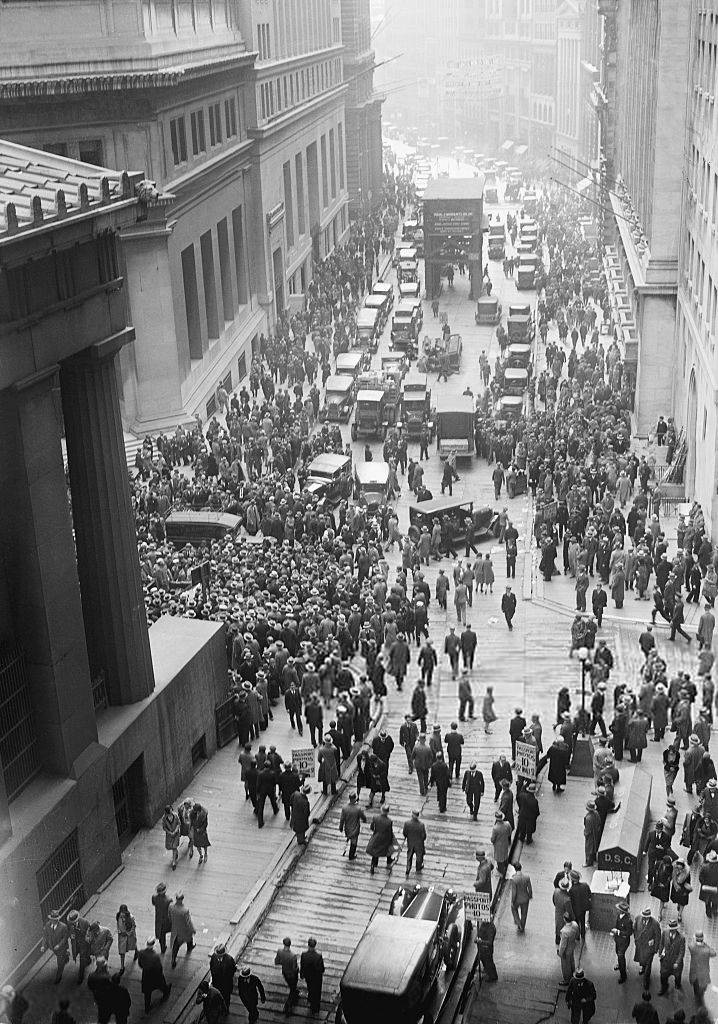
Multitud ante la Bolsa de Nueva York tras el crac de 1929
Multitud congregada ante la Bolsa de Nueva York tras el crac de octubre de 1929. Washington, Library of Congress (dominio público). Fuente

Sinopsis

Idea principalConclusión
El ciclo de las civilizacionesSpengler presenta la decadencia como fase final inevitable, que engendra resignación.
La crisis de 1929 como cicloSe repiten conductas financieras: agotamiento de la inversión y overshooting.
Emociones permanentesLa naturaleza humana no cambia y explica conductas que parecen erráticas.
Fases del cicloCrisis de liquidez, gasto público excesivo, caída de precios, inversión nula y quiebra bancaria.
El rumor como detonanteEl mercado responde con pánico y ventas a noticias no contrastadas.
Discurso de Hoover (1932)Admitir el riesgo de abandonar el patrón oro desató la especulación contra el dólar.
Retirada de depósitos (1929)Pérdidas de particulares, ejecuciones hipotecarias y desahucios masivos.
Hundimiento del consumoLa venta de automóviles cayó casi un 80 % entre agosto y diciembre de 1929.
La confianza recuperadaEl Reino Unido restauró el crédito de la libra con gestos de solvencia en 1931-1932.
Londres, centro financieroLa estabilidad de la moneda perseguía también la primacía financiera.
El poder de la sospechaLa comunicación de los dirigentes puede sostener, a corto plazo, una imagen de solidez.
La estabilidad presupuestaria olvidadaEl déficit cero de 2001 se diluyó con la reforma de 2006, en plena burbuja inmobiliaria.
Góngora y la decadenciaLas ruinas de las Soledades simbolizan el abandono de lo que fue grande.

Cronología, 1929-2012

1929Crac de Wall Street
Jueves y Martes Negros, 24 y 29 de octubre
1931La libra abandona el patrón oro
21 de septiembre
1932Discurso de Hoover en Des Moines
4 de octubre
1933EE. UU. suspende la convertibilidad en oro
Abril, presidencia de Roosevelt
2001Leyes de estabilidad presupuestaria
Ley 18/2001 y Ley Orgánica 5/2001
2006Reforma de la estabilidad presupuestaria
Ley 15/2006 y Ley Orgánica 3/2006
2007Crisis de las hipotecas subprime
Agosto, tensiones en los mercados interbancarios
2008Quiebra de Lehman Brothers
15 de septiembre
2011Reforma del artículo 135 de la Constitución
27 de septiembre
2012Ley Orgánica 2/2012
Estabilidad presupuestaria y sostenibilidad financiera

I. El ciclo de las civilizaciones

En La decadencia de Occidente, Spengler explica el carácter cíclico de las civilizaciones y su destrucción como fase última1. Este final inevitable genera, en la tragedia de las circunstancias, una resignación incondicional. Resignación que a muchos sirvió para soportar fatalidades. ¿También hoy, ante lo incierto del día a día y con miedo a alzar la mirada para escudriñar hasta el futuro más inmediato? Nada puede objetarse a los gobernantes de hoy porque nada se objetó a los gobernantes de ayer. Solamente que el ayer y el hoy han difuminado el mañana.

II. La crisis de 1929 como ciclo

La crisis de 1929 ha sido estudiada como manifestación de una economía cíclica, por la concurrencia de comportamientos financieros y económicos muy parecidos; especialmente, el agotamiento de las oportunidades de inversión debido a una sobreexpansión de la demanda consumista y de la inversión, el llamado overshooting (Kindleberger, 2009: 308)2.

Sus efectos durante los años sucesivos nos muestran aspectos que concurren en la actualidad, aunque no todos. En lo esencial, subsisten emociones que son permanentes, sea cual sea el momento histórico, porque pertenecen a la naturaleza del hombre, que se mantiene inalterable. Y a ellas debe acudirse para explicar comportamientos que pueden parecer erráticos.

El ciclo que se repite está compuesto por la crisis de liquidez, por presupuestos públicos extravagantes, por disminuciones de precios que quiebran el sistema monetario, por una inversión bruta cercana a cero y, finalmente, por un apocalipsis bancario (Rostow, 1971: 84)3.

III. Lo emotivo en la economía: miedo y confianza

Conocer las circunstancias de 1929 y de los años siguientes puede ayudarnos a evitar caer más hondo, porque saber nadar en las «formas» de la comunicación impide que los «fondos» se sumerjan más en el abismo. Lo emotivo en la economía ha operado en sentido positivo y negativo. Destacan, como ejemplos, los siguientes:

a) El miedo de los inversores a percepciones o noticias negativas sobre la solvencia económica de un país. No se trata de su autenticidad: basta la constancia de un rumor equívoco, fútil. Se generó pánico y ansiedad de liquidez, que motivó la venta de valores y divisas.

Ello ocurrió tras unas declaraciones de Hoover en Des Moines (Iowa, EE. UU.), el 4 de octubre de 1932, cuando mencionó «lo cerca que EE. UU. había estado de abandonar el patrón oro (…)»4. Este comentario desató una oleada mundial de especulación financiera contra el dólar.

Otro ejemplo es la cancelación de depósitos en Nueva York en 1929 por inversores extranjeros, bancos y corporaciones estadounidenses foráneas, sin motivo alguno. Ello generó pérdidas a inversores particulares. Estos, a su vez, para resarcirse de sus perjuicios, ejecutaron sus hipotecas y provocaron, en la mayoría de los casos, desahucios masivos.

El precio de la vivienda cayó rápidamente, junto con el de las materias primas y los automóviles. Desde agosto de 1929 se contrajo la venta de vehículos: de 440.000 unidades a 319.000 en octubre, a 169.500 en noviembre y a 92.500 en diciembre (Butler, 1969)5.

Dorothea Lange, Madre migrante (1936)
Dorothea Lange, Madre migrante (Migrant Mother), Nipomo, California, 1936. Washington, Library of Congress. Fuente

b) La recuperación de la confianza. Gran Bretaña recuperó la confianza de los mercados internacionales en la libra en enero de 1932.

El Gobierno británico anunció que el Banco de Inglaterra cumpliría los pagos de los créditos recibidos en el verano de 1931 sin mermar sus reservas de oro. También informó del pago adelantado y voluntario del impuesto sobre la renta en enero, cuando debía hacerse en marzo6.

La finalidad perseguida fue estabilizar la libra respecto al oro, pero también restablecer a Londres como centro financiero mundial (Einzig, 1935)7, cosa que hoy, en el siglo XXI, se pretende en detrimento de Alemania.

La sutileza financiera no casa con la realidad abrupta de los hechos. Y de ello cabe deducir que el mercado financiero es sensible a la simple sospecha, sin más. Las «políticas» de marketing sobre los ajustes financieros hechas por los dirigentes han podido ofrecer una imagen de solidez económica que, a la postre, ha dado resultados positivos, al menos a corto plazo. Es vivir en la mentira, en lo virtual, pero, al fin y al cabo, vivir, aunque sea muriendo.

IV. Una ley olvidada: la estabilidad presupuestaria

Reclamo la atención sobre un hecho que ha pasado inadvertido y que no ha merecido comentario alguno. En 2001 se aprobaron las leyes de estabilidad presupuestaria para todas las Administraciones públicas8. Estas normas permitían a las comunidades autónomas adoptar las medidas necesarias para alcanzar el déficit cero, ya fuera con una política de incremento de los ingresos públicos, ya mediante la reducción de los gastos, y sin que pudiera recurrirse a una mayor emisión de deuda pública como forma de financiación.

El propósito de aquellas leyes se vio truncado en 2006, al modificarse de forma sustancial el régimen de 20019 y entrar todos en un nuevo marco normativo que invitaba a caminar de cualquier modo en plena burbuja inmobiliaria, que enriquecía a las Administraciones por la vía de los impuestos.

La estabilidad presupuestaria en España

Leyes de 2001. La Ley 18/2001, General de Estabilidad Presupuestaria, y la Ley Orgánica 5/2001, complementaria, que aplicó sus principios a las comunidades autónomas (12 y 13 de diciembre de 2001).

Reforma de 2006. La Ley 15/2006 y la Ley Orgánica 3/2006 modificaron sustancialmente el régimen anterior (26 de mayo de 2006).

Reforma constitucional. El nuevo artículo 135 de la Constitución elevó a rango constitucional el principio de estabilidad presupuestaria (27 de septiembre de 2011).

Ley Orgánica 2/2012. De Estabilidad Presupuestaria y Sostenibilidad Financiera, texto único para todas las Administraciones públicas, hoy vigente con sus modificaciones (27 de abril de 2012).

Cuatro leyes en once años · Del déficit cero de 2001 al artículo 135

V. Epílogo: Góngora y la decadencia

Hoy la arquitectura del tiempo invita a reflexionar sobre la decadencia plasmada por Góngora en sus Soledades: asfixias implacables de una economía cuya estructura interna es incomprendida; desnaturalización del contexto humano; tránsito de la ética de lo difuso hacia un narcisismo evocador de lo bucólico vivido; de lo nacional al imperio y del imperio a la aldea, como catalizador de la ruindad de los hombres y de la decadencia del abandono y la soledad. Son sus versos10:

Aquellas que los árboles apenas
dejan ser torres hoy […]
las estrellas nocturnas luminarias
eran de sus almenas […].
Yacen ahora, y sus desnudas piedras
visten piadosas yedras:
que a ruinas y a estragos
sabe el tiempo hacer verdes halagos […].
Diego Velázquez, Luis de Góngora y Argote (1622)
Diego Velázquez, Luis de Góngora y Argote (1622). Boston, Museum of Fine Arts. Fuente

Notas

  1. Spengler, O. (1923-1927): La decadencia de Occidente. Bosquejo de una morfología de la historia universal, trad. de M. García Morente, Madrid: Espasa-Calpe. ↩
  2. Kindleberger, C. P. (2009), p. 308. Sobre el concepto, véase Kindleberger, C. P. y Aliber, R. Z. (2012): Manías, pánicos y cracs. Historia de las crisis financieras, Barcelona: Ariel. ↩
  3. Rostow, W. W. (1971): Politics and the Stages of Growth, Cambridge: Cambridge University Press, p. 84. ↩
  4. Hoover, H. (1932): «Address at the Coliseum in Des Moines, Iowa», 4 de octubre de 1932, en Peters, G. y Woolley, J. T.: The American Presidency Project, Santa Bárbara: Universidad de California. Texto del discurso. ↩
  5. Butler (1969). Ventas de automóviles en Estados Unidos, agosto-diciembre de 1929. ↩
  6. Einzig, P. (1933): The Comedy of the Pound, Londres: Kegan Paul, p. 56. ↩
  7. Einzig, P. (1935). ↩
  8. Ley 18/2001, de 12 de diciembre, General de Estabilidad Presupuestaria, y Ley Orgánica 5/2001, de 13 de diciembre, complementaria (BOE núm. 299, de 14 de diciembre de 2001). BOE. Hoy rige la Ley Orgánica 2/2012, de 27 de abril, de Estabilidad Presupuestaria y Sostenibilidad Financiera, dictada en desarrollo del artículo 135 de la Constitución, reformado en 2011. ↩
  9. Ley 15/2006 y Ley Orgánica 3/2006, ambas de 26 de mayo (BOE núm. 126, de 27 de mayo de 2006). BOE. ↩
  10. Góngora, L. de (1613): Soledades, «Soledad primera»; ed. de R. Jammes (1994), Madrid: Castalia. ↩

Para seguir leyendo

  • Galbraith, J. K. (1955): El crac del 29, Barcelona: Ariel (ed. española).
  • Kindleberger, C. P. (1985): La crisis económica, 1929-1939, Barcelona: Crítica.
  • Kindleberger, C. P. y Aliber, R. Z. (2012): Manías, pánicos y cracs. Historia de las crisis financieras, Barcelona: Ariel.
  • Comín, F. y Hernández, M. (eds.) (2013): Crisis económicas en España, 1300-2012. Lecciones de la historia, Madrid: Alianza.
  • Ley Orgánica 2/2012, de 27 de abril, de Estabilidad Presupuestaria y Sostenibilidad Financiera. Texto consolidado en el BOE.

Imágenes: Wikimedia Commons (dominio público).

Los despachos entre Felipe II y Álvaro de Bazán sobre la Gran Armada (publicado en El Confidencial Digital)

Sucesos contemporáneos · Serie microensayos Los despachos entre Felipe II y Álvaro de Bazán sobre la Gran Armada Entre mayo de 1587 y enero ...

Los despachos entre Felipe II y Álvaro de Bazán sobre la Gran Armada (publicado en El Confidencial Digital)